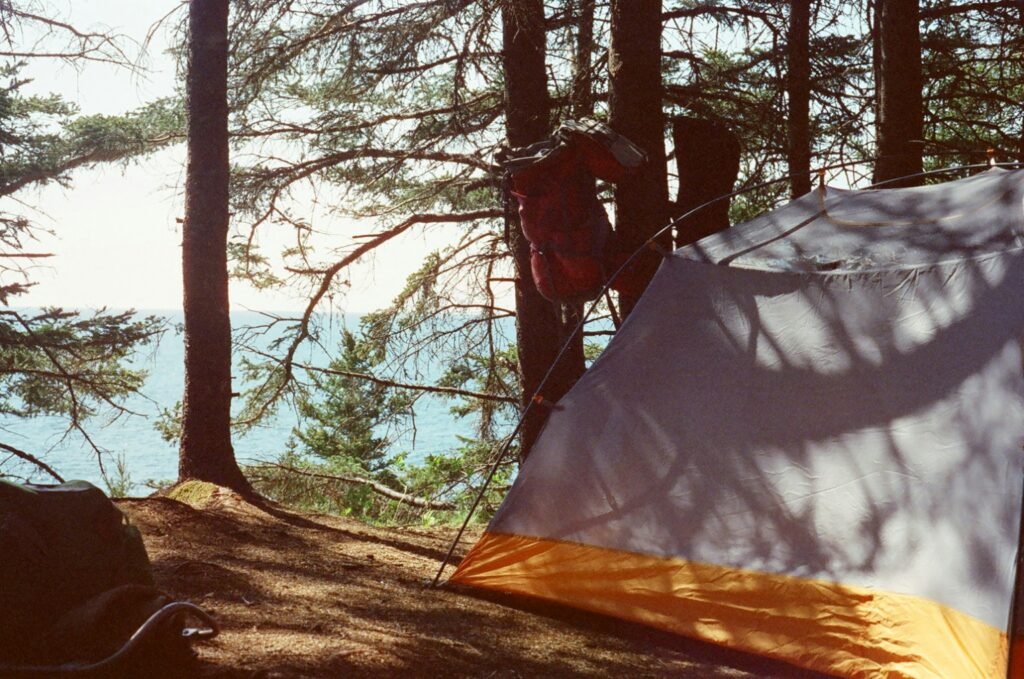
There’s a moment that happens after camp is technically ready.
The tent is up.
The gear is out.
Nothing is wrong.
And still, something feels unsettled.
It often shows up as a low hum in the background. A sense that you forgot something. That you misjudged the site. That you should be doing something—even though there’s nothing left to do.
For a long time, I assumed that feeling meant I’d done something wrong.
I’ve felt it on winter trips in upstate New York, standing still in the cold after everything was set. I’ve felt it on humid summer nights beside a lake in Georgia, when the air finally stopped moving and everything went quiet. I’ve felt it in the mountains of Idaho and Colorado, in places I’d looked forward to for months.
It always arrived the same way.
At first, it felt chaotic. Not dramatic—just uncomfortable enough to keep me from settling in. Sometimes it made me question whether camping was really for me at all. Nothing was actually wrong, but it didn’t feel that way yet.
That disconnect is what eventually sent me digging.
Psychologists have studied this mental shift for decades. Work in environmental psychology, often described through Attention Restoration Theory, suggests that natural environments help the brain step out of constant demand and into a more restorative state — not instantly, but gradually, as attention softens and pressure fades.
Much of this understanding comes from long-standing work by Stephen Kaplan and Rachel Kaplan, including their book The Experience of Nature, which explores why time outdoors often feels mentally different than time spent in built environments.
Knowing there was language for what I was feeling changed how I responded to it.
Now, when that unsettled feeling shows up, I don’t treat it as a problem to solve.
I’ll pull out a camping chair, something ordinary and familiar like, and set it down without much thought. Not positioned for anything in particular. Just placed.
I sit before it feels earned.
That moment matters. Not because of the chair, but because sitting interrupts the urge to keep fixing a feeling that can’t be fixed through movement.
This is the same fragile stretch many people recognize during arrival—the space where everything feels slightly off even though nothing has gone wrong. The mistake is assuming it needs correction.
I’ll usually pour something to drink next. A mug, a bottle, something simple. It gives my hands something to do while the rest of me slows down.
I sit.
I take a sip.
I let my eyes stop searching.
At first, the mind resists. Thoughts jump ahead. Dinner plans. Weather. Whether the site was the right choice. The urge to stand up and adjust something that doesn’t need adjusting.
That resistance is familiar to anyone who’s felt uneasy on a first solo trip or early camping experience, mistaking mental lag for a bad decision.
If you don’t rush past it, the feeling softens on its own.
Breathing deepens.
Shoulders lower.
Attention stops straining.
You start noticing what’s actually there instead of what you think should be.
Nothing dramatic happens. And that’s the relief.
Camping doesn’t settle in through effort. It settles in when attention finally loosens its grip. When the mind catches up to where the body already is.
The chair fades into the background. The drink becomes incidental. And without marking the moment, you realize you’re no longer arriving.
You’ve arrived.
That early discomfort wasn’t a sign you did something wrong. It was simply the space between daily life and being here.
Letting it exist—without trying to outrun it—is often all it asks.
And when it passes, the trip begins quietly, the way it always does.