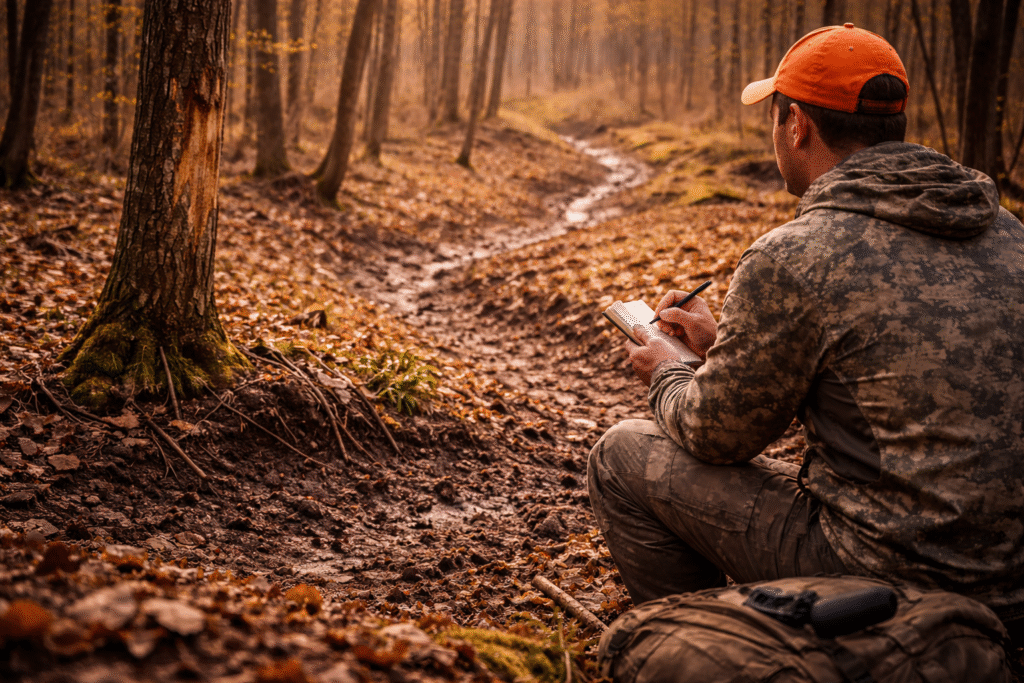
One of the biggest shifts that happens as you spend more time in the woods is simple, but not easy:
You stop trying to make something happen — and start paying attention to what already is.
This isn’t about tactics or shortcuts.
It’s about learning to see what the woods have been showing you all along.
And it’s one of the most important skills a hunter can develop.
Stillness Changes What You See
When you’re new to hunting, movement feels productive.
Walking. Adjusting. Repositioning.
It feels like doing something is better than doing nothing.
But over time, you learn that stillness reveals more than motion ever could.
When you sit quietly — without checking the clock or expecting immediate results — the woods begin to open up.
You start noticing:
- Subtle movement in the distance
- How deer prefer to travel edges instead of open ground
- Where trails quietly intersect
- How certain areas feel used, while others don’t
These observations don’t mean much on their own yet — and that’s okay.
Learning comes in layers.
The Woods Are Always Communicating
The woods are constantly giving information.
Not in loud or obvious ways — but through small, consistent signs.
Scrapes along a trail.
Rubs on young trees.
Beds tucked into cover.
Well-used paths leading toward food or water.
At first, these things may just look like “stuff in the woods.”
Over time, they begin to tell a story.
You don’t need to know exactly what to do with that information right away.
You just need to notice that it’s there.
Observation Comes Before Application
It’s tempting to jump straight to application.
What does this mean?
Where should I sit?
How do I hunt this spot?
But understanding always comes before strategy.
Before scrapes and rubs tell you when or how to hunt an area, they first teach you where animals spend time and how they move through the landscape.
Future posts will help break down how to interpret and apply these signs in a practical way — but none of that matters if you haven’t trained yourself to notice them in the first place.
Why Stillness Builds Confidence
Confidence doesn’t come from memorizing techniques.
It comes from recognizing patterns over time.
When you slow down and observe consistently, you begin to trust what you’re seeing. You’re no longer reacting emotionally to every sound or movement.
You start to understand:
- What’s normal
- What’s out of place
- What areas show repeated use
- How wind and terrain influence movement
That kind of confidence leads to better decisions — and better outcomes.
Paying Attention Without Pressure
One of the best times to build this skill is when there’s no pressure to perform.
Post-season walks.
Off-season scouting.
Sitting without expectations.
These moments allow you to observe bedding areas, food sources, and travel routes without rushing to conclusions.
They also give you space to reflect on what you’re seeing — and how it might matter later.
Small Observations Add Up Over Time
No single sign guarantees success.
But together, small observations form a clearer picture.
Scrapes near travel corridors.
Rubs pointing movement direction.
Bedding areas positioned for wind advantage.
Food and water sources connected by natural routes.
Many hunters develop the habit of reflecting on these details after time in the woods — not to overanalyze, but to track patterns across seasons.
That’s when understanding begins to grow.
Why Beginners Benefit Most From Slowing Down
For beginners, this approach removes pressure.
You’re not expected to understand everything at once.
You’re learning the language of the woods before being asked to speak it.
By becoming familiar with common terms — scrapes, rubs, bedding, food, water, travel routes — you begin to see hunting as a process instead of a puzzle.
That foundation makes future learning feel natural instead of overwhelming.
Learning the Land Before Trying to Hunt It
Every piece of land has its own rhythm.
Learning that rhythm takes time.
It requires walking when nothing is happening.
Watching when nothing moves.
Listening when nothing feels obvious.
This isn’t wasted time.
It’s how understanding is built — and how future success becomes more likely.
What Slowing Down Teaches Us
Slowing down teaches more than hunting skills.
It teaches patience.
It teaches awareness.
It teaches respect for the process.
And it reminds us that harvesting an animal is rarely the result of one decision — but of many small lessons learned over time.
When you learn to pay attention, the woods begin to show you where animals live, how they move, and why they choose certain areas.
Future posts will help define and apply those lessons.
For now, learning to notice is enough.