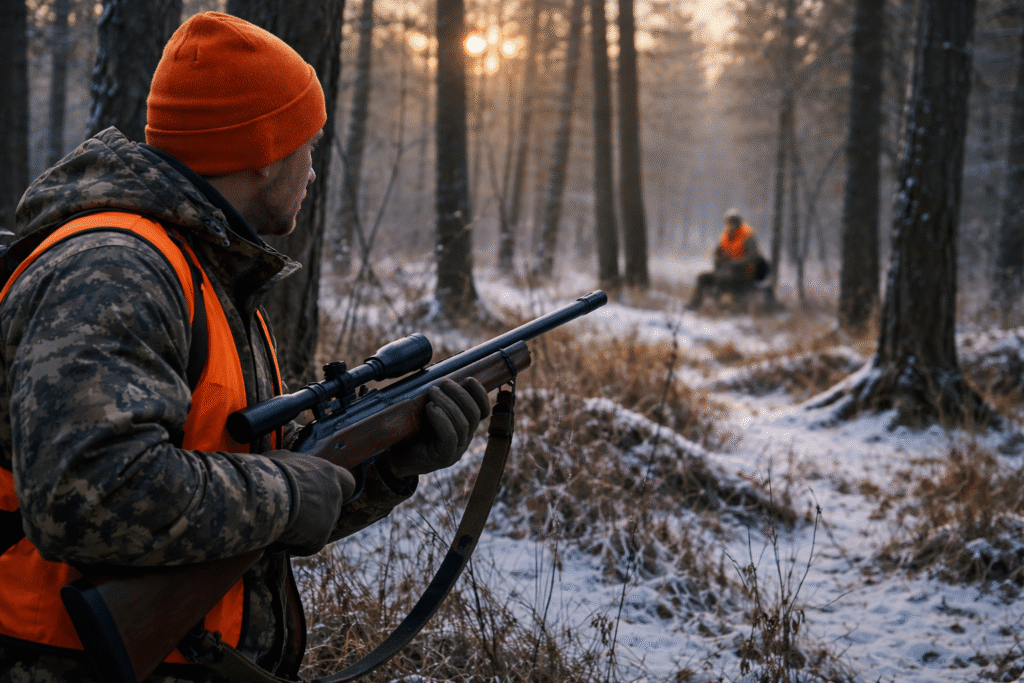
Because my father was in the military, we moved around a lot when I was growing up. And even in my adult years, life has taken me to many different places. That gave me the privilege of hunting in a wide range of terrain — mountains, pine forests, hardwoods, agricultural land, deep snow in upstate New York, and mild December days in the South.
Different landscapes teach different lessons.
But some lessons follow you everywhere.
One of the most important lessons I ever learned about hunting came on a bitterly cold, dark morning in the Southern Tier of New York.
A Morning I’ll Never Forget
It was one of those mornings where the cold settles into your bones. Snow covered the ground, and the woods were quiet in that way they only are before daylight.
We were hunting public land — an area known for being overcrowded. As my father and I pulled in, several trucks followed us. Four, maybe more. It was clear a lot of hunters had the same idea that morning.
We didn’t think much of it. We walked in, split up, and found our spots like we always did.
As I sat there, I watched flashlight beams weaving through the trees. One after another. Then disappearing. I counted at least ten hunters walking in that morning.
About an hour later, the sun started to rise.
That’s when I saw movement.
The Moment That Changed Everything
The deer appeared about forty yards in front of me.
My heart started pounding.
I tried to remember how to breathe.
I slowly brought my rifle to my shoulder.
But before I could settle in, something my father had drilled into my head since I was a kid came rushing back:
“Always look beyond your target.”
So I did.
I scanned the area beyond the deer — just like I’d been taught.
That’s when I saw it.
A small flicker of orange.
I immediately dropped my rifle.
I looked harder — and there he was.
A man sitting behind a tree about twenty-five yards in front of me.
He had apparently fallen asleep. The deer had walked past him at no more than ten yards.
I was frustrated at first. Anyone would be.
But then it hit me.
If I had pulled that trigger, I could have seriously injured — or killed — another person.
That outcome was avoided because my father had been relentless about firearm safety from the day I was old enough to hold a BB gun.
The Lesson That Stuck for Life
That morning burned one lesson into my mind forever:
Just because you have a shot doesn’t mean you should take it.
There are many reasons not to shoot — even when the opportunity is there.
Some are obvious.
Some are subtle.
All of them matter.
Reasons Not to Take a Shot
Over the years, I’ve learned that good hunters don’t measure success by how often they pull the trigger. They measure it by the decisions they make when it matters most.
Here are just a few reasons a responsible hunter might choose not to take a shot:
- You see something — or someone — in your firing lane
- The animal is moving through thick brush and you can’t clearly see vitals
- The angle is poor or unsafe
- You see antlers, but you’re not certain the deer meets legal requirements
- Your nerves won’t settle, and you can’t zero in confidently
None of these situations mean failure.
They mean restraint.
Why Ethical Decisions Matter More Than Results
Without getting into graphic detail, there are few things worse in hunting than a poor shot.
A shot that causes unnecessary suffering.
A shot that leads to an animal never being recovered.
Those outcomes stay with you.
Ethical hunting means doing everything you can to avoid those situations — even if it means letting an animal walk.
That responsibility doesn’t begin when you see a deer. It begins long before the season starts, with preparation, practice, and honest self-awareness.
Teaching the Next Generation the Right Way
I teach my kids the same lesson my father taught me:
Just because you see it doesn’t mean you have to shoot it.
If every safety and ethical box isn’t checked in your mind — you don’t shoot. Period.
This isn’t about being timid.
It’s about being responsible.
Especially on public land, you will encounter hunters who don’t live by this code. That’s unfortunate — and it’s also how accidents happen.
Teaching kids to slow down, think, and make ethical decisions is just as important as teaching them how to hunt.
Maybe more so.
Public Land Requires Extra Awareness
Public land hunting adds another layer of responsibility.
You’re sharing space with people you don’t know. People with different experience levels. People who may not always do things the right way.
That’s why situational awareness is critical.
Knowing what’s beyond your target.
Understanding where others might be moving.
Recognizing when conditions aren’t safe.
These habits aren’t optional — they’re essential.
Hunting Builds Character When Done Right
Hunting isn’t just about harvesting an animal.
It’s about learning restraint.
Respect.
Patience.
Responsibility.
That morning in the Southern Tier of New York taught me that one decision can change everything — for better or worse.
The right decision didn’t fill a tag.
But it kept everyone safe.
And that matters far more.
Why This Lesson Still Matters
As hunters, we’re entrusted with powerful tools. With that comes responsibility — not just to wildlife, but to each other.
Good hunters don’t rush shots.
They don’t chase pressure.
They don’t ignore uncertainty.
They pause.
They think.
And they remember that walking away is sometimes the best decision they’ll make all season.
Final Thoughts
Hunting has taken me across states, terrain, and seasons. But no matter where I’ve been, one lesson remains constant:
A shot is never owed to you.
Taking one should always be a deliberate, ethical decision — made with safety, respect, and responsibility in mind.
That’s how hunting stays safe.
That’s how traditions continue.
And that’s how the next generation learns what it truly means to be a hunter.
“If you’re new to hunting, start here: slow down, stay aware, and never let the moment rush your decision-making.”