There’s a common way hunting is talked about that has never quite sat right with me.
It reduces the entire experience to a handful of moments — the shot, the harvest, the photo, the tag filled. Everything before and after those moments gets compressed into background noise, as if it only exists to support the final outcome.
But when I think back on the hunts that shaped me most, very few of them are defined by what I took.
They’re defined by what I decided.
That understanding didn’t arrive all at once. It came slowly, over years of walking into the woods without guarantees, sitting still longer than was comfortable, and learning to live with the weight of decisions that never made it into a picture.
At its core, hunting isn’t a collection of actions.
It’s a practice of judgment — repeated, quiet, and often unseen.
The Myth of the Defining Moment
I was reminded of this recently while talking with a buddy I met a few years ago.
We were catching up, and I mentioned I was going hunting on opening day. The conversation drifted naturally, and he told me he’d never been — but that it was something he’d always been interested in trying.
I asked him a simple question:
“What do you know about hunting?”
Without hesitation, he said, “You sit in a tree, wait until a deer walks by, and take the shot.”
I told him that description probably sums up the last couple minutes of a good hunt — at most.
Everything before that moment is where the real work happens.
His answer wasn’t wrong. It was just incomplete. And it highlighted how deeply the defining-moment myth shapes how hunting is understood from the outside.
To someone who hasn’t done it, the action looks like the whole story.
To someone who has, the action is just the final punctuation mark on a very long sentence.
The Work That Happens Long Before the Shot
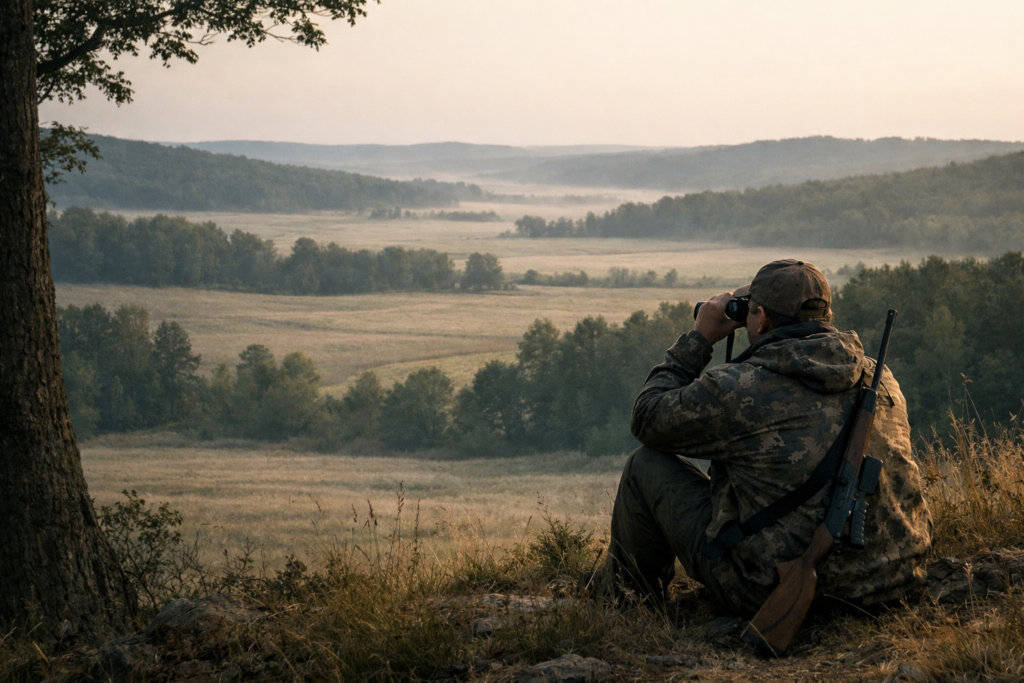
As we kept talking, I mentioned how important glassing is — both before the season and during a hunt.
He looked at me like I was speaking another language.
So I explained that glassing means getting out ahead of time, or sitting back during a hunt, using binoculars or a spotting scope to observe from a distance. Looking for animals. Looking for movement. Looking for patterns. Learning how wildlife uses the land when no one is pressuring them.
It’s slow work. Quiet work. And most of it happens without ever touching a trigger.
From there, we started listing everything that has to align before a shot is even possible:
- Where the animal is traveling
- How the wind is moving
- What the distance actually is
- Whether the angle is ethical
- Whether the conditions match your ability
- Whether taking that shot makes sense today, not just legally — but responsibly
By the time a trigger is pulled, the decision has already been made dozens of times over.
The shot doesn’t create judgment.
It reveals it.
Judgment Lives in the Space Between Hunts
One of the easiest mistakes to make is thinking judgment only shows up when something is happening.
In reality, it shows up most clearly when nothing is.
It’s there in the off-season, when no one is watching and there’s no pressure to perform. It’s there when you’re glassing from a distance with no guarantee you’ll even see an animal. It’s there when you’re learning land without expecting anything back from it.
Those moments don’t look productive from the outside. But they’re where judgment gets practiced.
They’re where patience replaces urgency.
Where observation replaces movement.
Where familiarity replaces expectation.
Judgment practiced only when it’s convenient isn’t judgment at all.
It’s reaction.
Why Restraint Isn’t Hesitation
Restraint is often misunderstood in hunting conversations.
It gets framed as indecision. As doubt. As a lack of confidence.
In reality, restraint is often the clearest sign that judgment is working.
Passing on a shot isn’t about fear. It’s about awareness — of conditions, of distance, of ability, and of consequence. It’s understanding that not every legal opportunity is a responsible one, and that the difference between the two isn’t always obvious in the moment.
Sometimes that awareness comes purely from experience.
Sometimes it’s supported by tools that encourage observation before action rather than speed or certainty.
Restraint requires more confidence than action does, because it leaves you with nothing to point to afterward.
No proof.
No validation.
Just the knowledge that you made a decision you can live with.
The Quiet Weight of Unseen Decisions
Most of the ethical weight of hunting is carried in private.
No one sees the hours spent glassing with nothing happening.
No one sees the shot you didn’t take.
No one sees the day you decided to leave early because something didn’t feel right.
Those decisions don’t make stories that travel well. But they’re the ones that determine whether hunting remains something you respect — or something you slowly justify.
Judgment isn’t about being perfect.
It’s about being honest when no one is around to keep you accountable.
Why This Matters for the Next Generation
When hunting is reduced to outcomes, it becomes difficult to pass on responsibly.
Kids don’t learn judgment by watching success.
They learn it by watching decisions.
They notice when you slow down.
They notice when you explain why you’re waiting.
They notice when you walk away without frustration.
Those moments teach them that hunting isn’t a transaction.
It’s a relationship — with land, wildlife, and self-control.
Action Reveals Judgment — It Doesn’t Create It
The shot doesn’t define the hunter.
It reveals what was already there.
Whether patience was practiced.
Whether respect was internalized.
Whether responsibility was carried quietly long before it was tested.
When hunting is approached as a practice of judgment rather than a series of actions, the pressure shifts.
Success stops being something you chase.
Failure stops being something you fear.
And responsibility stops being something you explain after the fact.
It becomes something you live out — decision by decision — long before anyone else ever notices.
Closing Thought
Hunting will always involve moments of action.
But those moments are brief.
What lasts is the pattern of judgment that surrounds them — the choices made when no one is watching, the restraint practiced without reward, and the consistency that turns experience into wisdom.
If hunting shapes character at all, it does so quietly, over time, through judgment practiced again and again.
And that — more than any single moment — is what defines the hunter you become.