When I first started hunting on my own, I learned very quickly that just sitting in the woods wasn’t enough.
One afternoon as I was leaving the woods, I ran into a man who had clearly been hunting the area for years. He asked if I had seen anything. I told him I hadn’t seen a single deer. He looked surprised and said he had hunted that section for over 30 years and usually saw plenty of deer.
We talked for a while, and before he left he gave me some advice. He told me to walk about 300 yards into the woods until I found a ridge. Then he said to follow that ridge until it reached a saddle where deer bedding areas were nearby. He told me it was one of his secret spots.
At the time I was young and excited. But on the drive home, reality hit me.
I knew what a ridge was… but I had no idea what a saddle was.
I eventually found that spot after several trips into the woods, not because I understood the terrain terms, but because I walked until I found a dense bedding area filled with game trails and sign.
That experience is what pushed me to start learning how to read topography for deer hunting. Once I understood terrain and topographic maps, the woods started to make much more sense.
Experienced hunters rarely see deer by accident. They understand the terrain and how deer naturally move through it.
If you’re learning the fundamentals of deer movement, [Understanding Deer Movement (What Actually Matters and What Doesn’t)] explains the bigger picture of what actually influences deer behavior.
Understanding terrain is one of the most powerful tools hunters can learn.
Why Terrain Matters in Deer Hunting
Many beginner hunters assume deer move randomly through the woods.
But deer are incredibly efficient animals. They tend to move through terrain in ways that provide safety, energy efficiency, and access to food.
Terrain influences deer movement in several important ways.
Safety
Deer prefer terrain that allows them to see danger and escape quickly. Elevated ground and areas with good visibility help them stay alert.
Travel Efficiency
Just like people, deer usually choose the easiest path when moving through the woods. Terrain features such as ridges, benches, and valleys often guide this movement.
Wind Advantage
Terrain shapes wind flow. Deer frequently travel routes where wind helps them detect danger.
Bedding Areas
Certain terrain features naturally provide cover and security, making them ideal locations for bedding.
Once hunters begin to recognize these terrain patterns, they can start predicting where deer are most likely to travel.
How to Read Topography for Deer Hunting
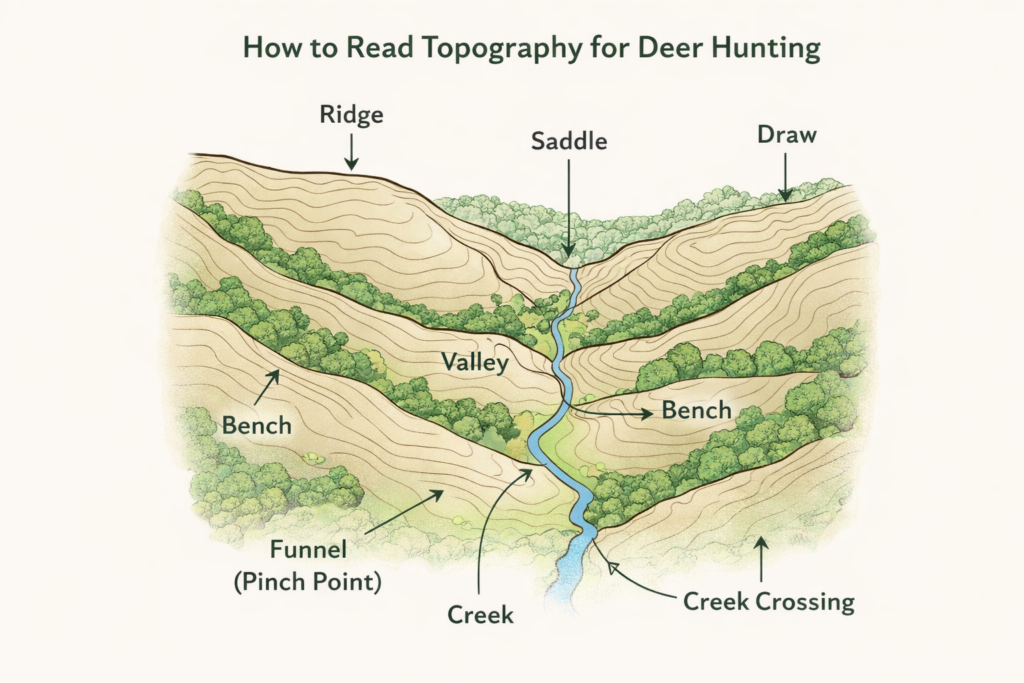
Learning how to read topography for deer hunting starts with understanding contour lines on a topographic map.
Topo maps use contour lines to represent elevation changes across the landscape.
Each contour line represents a specific elevation level. When you see multiple lines close together, it means the terrain rises or falls quickly. When the lines are spaced farther apart, the terrain is more gradual.
A few basic rules make topo maps easier to understand:
• Close contour lines mean steep terrain
• Wide contour spacing means gentle slopes
• Circles or loops usually indicate hills or peaks
• V-shaped lines often show valleys or draws
Once you understand these basics, a topographic map becomes a powerful tool for visualizing the landscape before you ever step into the woods.
Hunters use these maps to locate terrain features that naturally guide deer movement.
If you want to explore real topographic maps before scouting an area, the U.S. Geological Survey provides free maps that cover the entire United States. Studying these maps can help you begin recognizing ridges, valleys, saddles, and other terrain features before ever stepping into the woods. I would highly recommend checking this out. This site alone will change the way you see the woods.
[USGS Topographic Maps]
Understanding Common Terrain Features Hunters Look For
Several terrain features consistently influence how deer travel through an area.
Understanding these features is one of the biggest steps toward reading terrain effectively.
Ridge
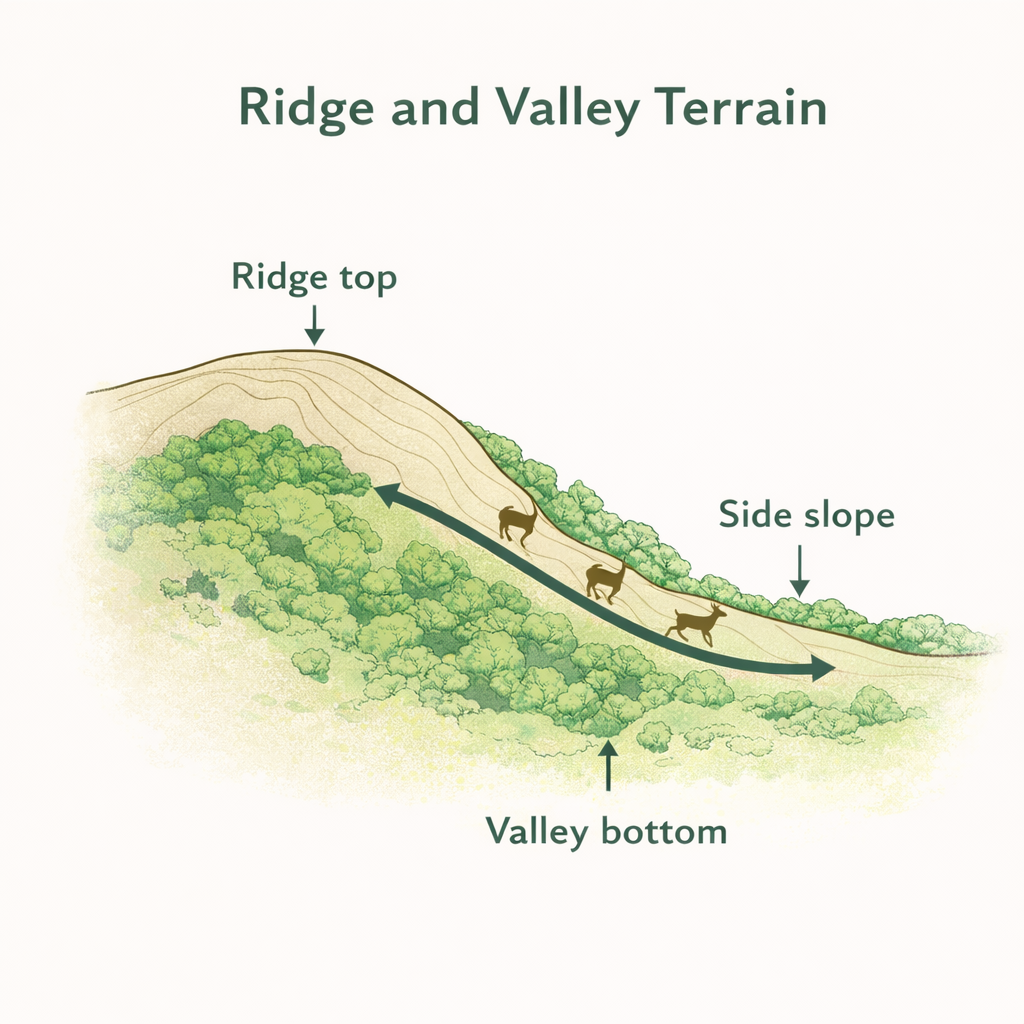
A ridge is a long elevated strip of land that runs between lower areas.
Deer often travel along ridges because they allow them to move efficiently while maintaining visibility and wind advantage.
Ridges frequently act as natural travel corridors.
Valley
A valley is the low area between two ridges.
Water sources, vegetation, and natural travel routes often exist in valleys. Deer commonly move through these areas when traveling between feeding and bedding locations.
Saddle
A saddle is a low point between two higher ridges.
When deer travel from one ridge to another, they often cross through saddles because it requires the least amount of climbing.
Saddles naturally funnel deer movement and are one of the most commonly hunted terrain features.
Bench
A bench is a flat shelf on the side of a hillside.
Benches give deer an easier path to travel along steep terrain. Instead of climbing directly up or down a hill, deer often follow these flat shelves along the hillside.
Benches are commonly used travel routes.
Funnel
A funnel is a terrain feature that forces deer movement through a narrow area.
Funnels can occur where terrain features pinch together, such as between steep hillsides, thick cover, or water.
Because deer movement becomes concentrated in these areas, funnels often create high-probability hunting locations.
Draw
A draw is a small valley or depression that cuts into a hillside.
Draws often guide deer movement as they travel between ridges or bedding areas. Deer frequently use draws because they provide cover and an easier path through terrain.
How Hunters Use Topographic Maps to Find Deer
Topographic maps allow hunters to study terrain long before they ever set foot in the woods.
By studying elevation changes and terrain features, hunters can identify areas where deer movement is likely to occur.
Some features hunters often look for include:
• saddles between ridges
• ridge crossings
• benches along hillsides
• natural funnels
• likely bedding areas
When several of these features come together, they can create extremely predictable travel routes for deer.
This is why experienced hunters often spend hours studying maps before scouting an area.
Terrain often reveals where deer are likely to travel before the first scouting trip even begins.
How Terrain, Wind, and Thermals Work Together
Terrain doesn’t just affect where deer travel. It also influences wind and thermals.
Wind direction can change as it moves across hills, valleys, and ridges. Thermals—rising and falling air currents—also move differently depending on terrain.
Understanding how terrain affects scent movement is an important part of stand placement.
Two topics that expand on this idea include:
[How Wind Affects Deer Movement]
[How Thermals Affect Deer Movement]
These factors combine with terrain to shape how deer use the landscape.
Real World Terrain Observation While Hunting
While topographic maps are powerful tools, real understanding often develops while sitting in the woods.
Experienced hunters constantly study the terrain around them.
They scan the woods repeatedly, looking for subtle terrain changes and travel routes.
Over time, hunters start noticing patterns:
• deer appearing on the same ridge lines
• movement along benches
• crossings through saddles
• travel routes through funnels
Eventually something interesting happens.
Hunters begin to predict where deer will appear before they actually see them.
That ability usually comes from understanding terrain and how deer naturally move through it.
Using Digital Maps and Mapping Apps for Hunting
Modern mapping tools have made terrain study much easier.
Many hunters now use digital maps and mobile apps to study terrain from home or even while scouting in the field.
These tools allow hunters to view topographic maps, aerial imagery, and terrain layers that highlight elevation changes.
Mapping apps can help hunters identify:
• ridges and valleys
• potential funnels
• bedding areas
• terrain crossings
Many hunters rely on mapping tools as part of their preseason planning. In fact, if I’m going out scouting, I always download the topo map first. This way I’ve already studied the terrain to determine the best areas to scout.
Frequently Asked Questions
How do you read a topographic map for hunting?
Contour lines represent elevation changes. When lines are close together, terrain is steep. When they are spaced farther apart, the terrain is more gradual. Hunters use these patterns to identify ridges, valleys, and other terrain features.
What terrain features attract deer movement?
Common terrain features that influence deer movement include ridges, saddles, benches, funnels, and draws.
What is a saddle in deer hunting?
A saddle is a low point between two higher ridges. Deer often cross through saddles because they require the least amount of climbing.
Why do deer travel along ridges?
Ridges allow deer to move efficiently while maintaining visibility and wind advantage. They often act as natural travel corridors.
How can terrain help you predict deer movement?
Terrain shapes how deer travel through the woods. Once hunters learn to recognize terrain features that guide movement, they can often predict travel routes before seeing deer.
Conclusion
Understanding terrain is one of the most powerful skills a hunter can develop.
Once you learn how to read topography for deer hunting, the woods start to reveal patterns that were once invisible.
Ridges, saddles, benches, funnels, and draws all guide deer movement across the landscape.
Instead of feeling random, deer travel begins to make sense.
And when terrain starts making sense, choosing where to hunt becomes much easier.